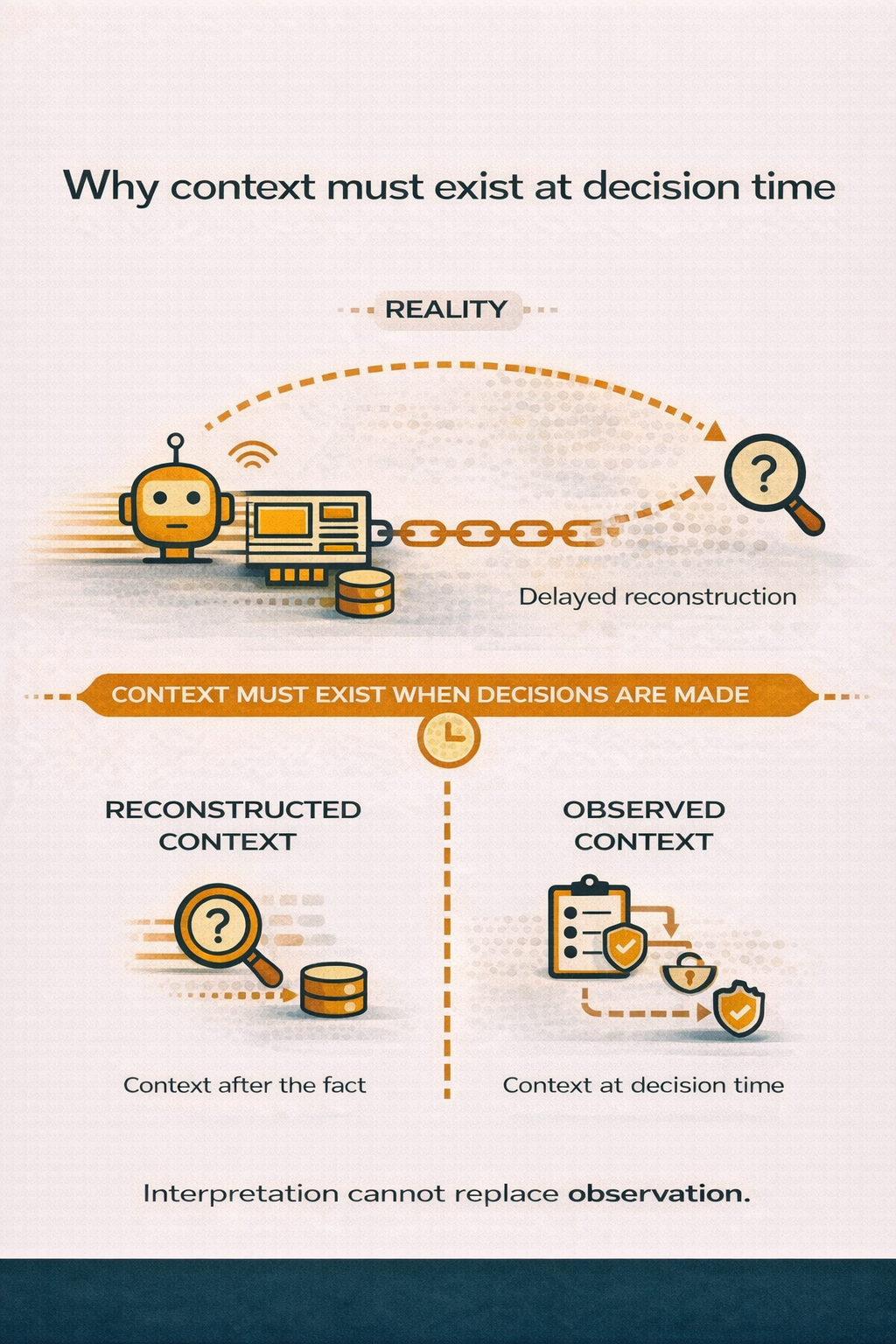
Why context must exist at decision time
When systems fail audits, the root cause is often described as missing data.
In reality, the data is usually there.
What is missing is context.
Reconstruction is not observation
Many architectures rely on reconstruction.
Logs are collected. Files are stored. Data is moved between systems.
Later, analysts attempt to rebuild what happened.
This approach is fragile.
Reconstructed context is an interpretation. Observed context is evidence.
Decisions happen in the moment
Decisions are made at a specific point in time.
Based on:
- the information available then
- the system state at that moment
- the rules in effect
- and the authority granted
If context is not captured at that moment, it cannot be recreated reliably later.
Why this matters in automated systems
As systems become faster and more autonomous, the window for human interpretation disappears.
Decisions propagate instantly. Effects accumulate.
Without explicit context at decision time, accountability dissolves.
Context as an architectural responsibility
Context is not metadata added later. It is not a reporting concern.
It is a design responsibility.
Systems must be built so that decisions carry their context with them.
Decisions without context cannot be explained.
Only then can behavior remain explainable, auditable, and trustworthy.